*This article contains advertisements and PR (A8.net affiliate. If an account is opened or a transaction is made via the links in the article, the author may receive a commission)
“I wonder if I should start NISA soon.”
Even if you think that, don’t you hesitate when it’s time to actually open an account?
If I have a cryptocurrency account, can I just start with that?
If I need to open a separate one, where should I open it?
When you open a brokerage firm’s website, the words “0 yen commission” are lined up, and you don’t even know what to believe or how to choose.
By the time you finish reading this article, you will be able to:
-
Stop being confused about “where and what kind of account to open”
-
Look at “0 yen commission” and be able to verify for yourself, “0 yen for which transaction and under what conditions?”
-
Compare DMM Stock or any other brokerage firm using the same 3 criteria and make your own decision
(NISA is a national system where profits and dividends earned from investments up to a certain amount are tax-free)
“In the first place, why are you talking about stocks on a cryptocurrency note?”
In a previous article titled “Retirement money and cryptocurrency, what is the difference from NISA?”, I wrote that cryptocurrency is not currently included in the products eligible for NISA.
When that happens, the next question that arises is, “So, where should I open an account if I want to do NISA?”
So this time, using DMM Stock as an example, I will read the official page together with AI.
I have never used DMM Stock, so instead of giving my impressions of using it, I will read what is written on the official page, giving equal weight to both the good points and the points to be aware of.
There are 3 mysteries I want to investigate.
-
Can you start stocks and NISA with a cryptocurrency account?
-
How do you distinguish between brokerage firms? Is DMM Stock the same company as that DMM Bitcoin?
-
What is written next to “0 yen”?
This article does not recommend DMM Securities.
Deciding not to start, or to compare with other companies after finishing reading, is also a perfectly valid answer.
(The conversation between Marco and the AI has been organized for readability. The AI’s explanations have been verified based on the sources at the end. The information is current as of November 12, 2026. Fees and other details are subject to change.)
Now, let’s start with the most basic question.
Mystery 1: “If I have a cryptocurrency account, can I also start NISA?”
Marco: Many people have accounts at cryptocurrency exchanges, right?
Can’t I start NISA there too?
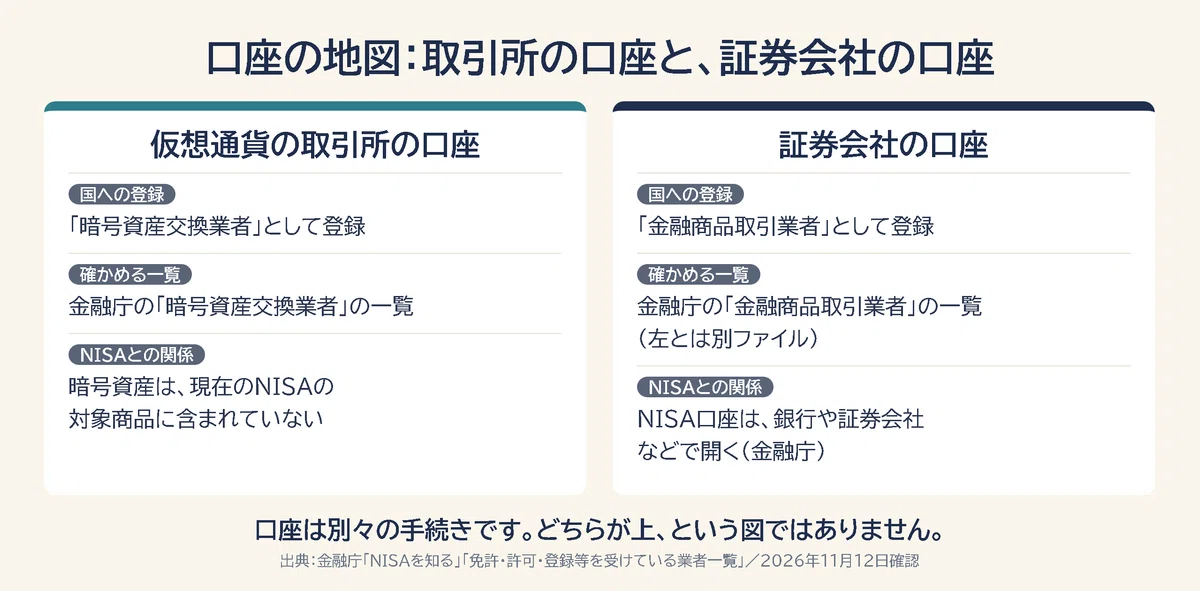
AI: The Financial Services Agency’s “Learn about NISA” page states that to use NISA, “you need to open a NISA account at a bank or securities company.”
Marco: It doesn’t say “You cannot open one at a cryptocurrency exchange,” though.
AI: Correct. I could not find any official document that explicitly states that. Therefore, I will not say it is “absolutely impossible.” What I can say is that the guidance is to open a NISA account at a bank or securities company. Also, the procedure is separate from that of a cryptocurrency exchange account. Even if a company in the same group operates both cryptocurrency and securities businesses, the accounts are separate. It is not a rule that “if it’s the same group, it’s one account.”
Marco: If we compare it to shops, it’s like a fishmonger and a pharmacy. Both require government permission and registration, but what they sell and the rules they follow are different.
AI: That is easy to understand. It’s not a matter of which one is superior. It’s that what they handle and the rules they follow are different.
Marco: NISA had other rules, right?
AI: According to the Financial Services Agency’s explanation, they are as follows:
-
You can only open one NISA account per person
-
You can change your financial institution on a yearly basis
-
However, if you have already purchased stocks in your NISA account at the previous financial institution within that year, you cannot change it for that year (changes take effect from the following year)
-
You cannot use the two NISA quotas (the Tsumitate Investment Quota and the Growth Investment Quota, which have different annual limits and eligible products) at different financial institutions
Marco: So it’s like only being able to have one medical examination card, and you can only change it once a year?
AI: I think that is an easy-to-understand analogy. That is why you want to be a little careful when choosing where to open one initially. Even if you buy and sell through NISA, it doesn’t mean you won’t have losses. The tax exemption only applies to the taxes on profits.
Marco: I see. Then the next question is “which securities company to choose.” What should I look at?
Mystery 2: “How can I tell the difference between securities companies?” “Is DMM Stock the same company as DMM Bitcoin?”
Marco: When choosing a cryptocurrency exchange, the basic rule was to check for ‘government registration,’ right? Is it okay to use the same approach for securities companies?
AI: The approach is the same. Securities companies are companies registered with the government as ‘Financial Instruments Business Operators.’ You can find a list of Financial Instruments Business Operators on the Financial Services Agency’s page titled ‘List of Operators with Licenses, Permits, or Registrations.’ The list of Crypto Asset Exchange Operators is on the same page, but in a separate file.
Marco: Oh, so the lists are split into two.
AI: Yes. Therefore, even though the way to verify them is the same, the place you look is different. You compare the company name (trade name) and registration number with the information displayed on the official website and the list. There is also a page called ‘Financial Services Provider Search’ on the Financial Services Agency’s website. It’s like checking a government registry to verify that a business license is posted at a storefront.
Marco: How does DMM Stock display this?
AI: According to the official DMM Stock page, the operating company is DMM.com Securities Co., Ltd. It is displayed as a Type 1 Financial Instruments Business Operator and Type 2 Financial Instruments Business Operator, with ‘Kanto Local Finance Bureau (Kinsho) No. 1629.’ It also states that it is a member of the Japan Securities Dealers Association, etc. (verified on November 12, 2026).
Marco: So if I look at that on the Financial Services Agency’s list, I can see if it’s truly registered.
AI: Yes. However, this article does not include the verification results from the Financial Services Agency’s list. After reading this article, please try searching for ‘DMM.com Securities’ and ‘No. 1629’ yourself using the list or the Financial Services Provider Search. That is the first thing to ‘verify.’
Marco: By the way, is DMM Stock the same company as DMM Bitcoin? The names are similar, and it’s confusing.
AI: They are different companies. DMM Stock is operated by DMM.com Securities Co., Ltd. DMM Bitcoin is operated by DMM Bitcoin Co., Ltd., and their trade names (company names) are different. As we summarized in the previous article, DMM Bitcoin ceased operations, and customer accounts and deposited assets were transferred to SBI VC Trade on March 8, 2025. Even if the names are similar, they are not necessarily the same company. You should distinguish them by company name (trade name) and registration number.
Marco: So it’s not like it’s safe because it’s a different company from the one that had the incident, nor is it necessarily a cause for concern, right?
AI: That’s correct. We are not using that as a basis for judgment in this article. Just because the names are similar doesn’t mean they are the same company. Look at the registration number and trade name. That is all.
Marco: One more thing. Can you buy cryptocurrency on DMM Stock?
AI: DMM Stock is a service for trading stocks and similar assets; it is not an exchange service for buying and selling cryptocurrency. Note that the same operating company does provide, as a separate service, trading targeting crypto assets (Crypto Asset CFD; a trade where you exchange the difference in price movements, which allows for large trades with small capital, but also carries the risk of large losses) (verified on the DMM.com Securities corporate site on November 12, 2026). This is a service separate from DMM Stock and is not covered in this article.
Marco: So I need to look at each service individually. Even if a company is registered, it doesn’t mean you won’t lose money, right?
AI: Yes. Registration means the company is ‘registered with the government,’ not that you ‘won’t lose money.’ Securities companies also have a mechanism called the Japan Investor Protection Fund. Their official company profile also indicates that they are a member. However, according to the official Japan Investor Protection Fund page, this fund is a mechanism that compensates up to 10 million yen per customer in cases where a securities company violates the rules of segregated management (managing customer assets separately from company assets) and becomes unable to return the assets. It states that it does not compensate for losses due to price declines. I think it’s best to remember that it’s not ‘safe because they are a member,’ but rather ‘price declines are not compensated.’ Please check the official Japan Investor Protection Fund page for the products and conditions covered by the compensation.
Marco: So, there is a ‘safeguard for when the warehouse loses the luggage you entrusted,’ but it doesn’t cover ‘the drop in the value of the contents of the luggage,’ right?
AI: That analogy is correct.
Marco: Alright, Mystery 2 is solved. Next is the money talk I’m most curious about.
Mystery 3: “What is written next to ‘0 yen’?”
Marco: You often see ‘0 yen commission’ in advertisements, don’t you? I wonder if DMM Stock is the same.
AI: If you read the official ‘Commissions and Risks’ page for DMM Stock, there are both transactions listed as 0 yen and those that are not. From what I have read, ‘0 yen’ is always paired with words specifying ‘which transaction’ and ‘under what conditions’.
Marco: So, you have to read it as a set of three things?
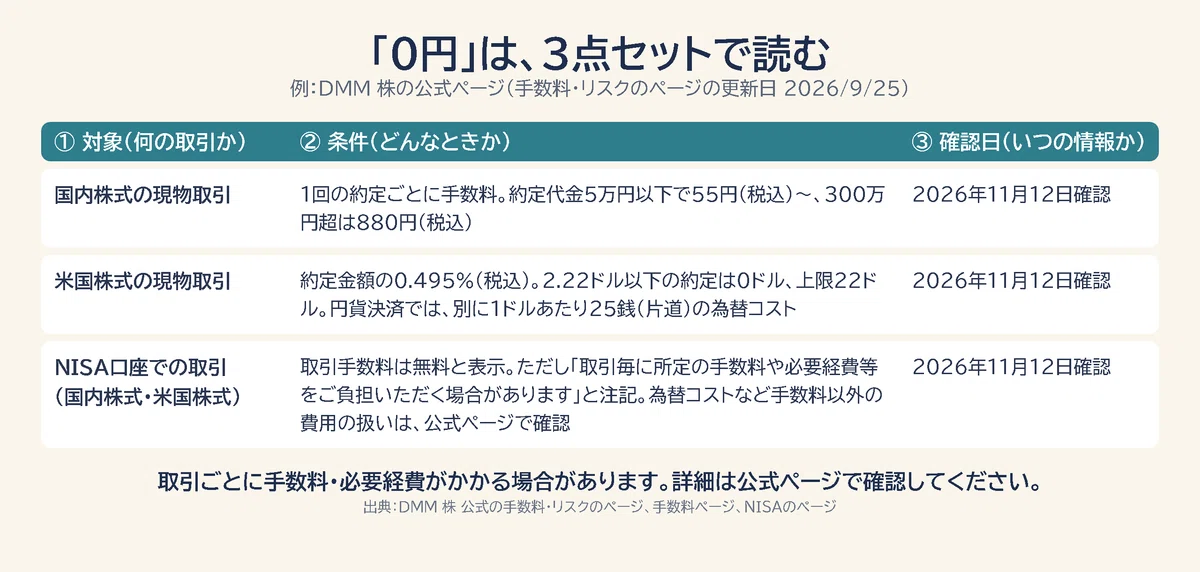
AI: Yes. They are the following three:
-
1. Subject: What kind of transaction is it?
-
2. Condition: Under what circumstances?
-
3. Confirmation Date: When is this information from?
It’s like reading the small print for ‘free shipping’ in online shopping (e.g., ‘on purchases over X amount’).
Marco: Tell me the actual details in order. First, Japanese stocks.
AI: For domestic stock spot trading (regular trading where you buy and sell within the range of money you have), a commission is charged for each execution (when an order is filled). If the execution amount is 50,000 yen or less, it is 55 yen (tax included). As the execution amount increases, the commission also rises, reaching 880 yen (tax included) for amounts over 3 million yen (confirmed on November 12, 2026, on the official commission page). In other words, the ‘…’ in ’55 yen ~’ applies to executions of 50,000 yen or less, and it goes up as the amount increases.
Marco: So it’s not 0 yen. What about US stocks?
AI: For US stock spot trading, the commission is 0.495% (tax included) of the execution amount. It states that it is 0 dollars if the execution amount is 2.22 dollars or less, with a cap of 22 dollars (confirmed on November 12, 2026, on the official commission page). It only becomes 0 dollars for very small executions. Furthermore, when buying or selling US stocks by settling in yen, it is noted that a currency exchange cost of 25 sen per dollar (one way) is charged separately from the commission.
Marco: That sounds like a currency exchange booth at an overseas airport. There is a difference when converting from yen to dollars and when converting back from dollars to yen.
AI: That is a good way to think about it. It is stated that if you settle in dollars, there is no currency exchange cost at the time of trading, but when you exchange yen and dollars separately, a cost of 25 sen each way is charged. Please check the official page for detailed conditions.
Marco: What about NISA?
AI: For NISA domestic stocks and US stocks, trading commissions are displayed as free (official commission page). However, the DMM Stock NISA page also states, ‘While account management fees and account registration fees are free, you may be required to pay prescribed commissions or necessary expenses for each transaction.’ This note is in the same sentence as the statement that management fees are free. Therefore, it cannot be read as ‘everything is always 0 yen.’ Also, the handling of costs other than commissions, such as currency exchange costs when trading US stocks in a NISA account, was not written on the pages I read. Please check the official page.
Marco: There was also a campaign page on the official website, right?
AI: Yes. There is a page for a currency exchange cost campaign. The period is stated to be until August 31, 2026, so it has already ended as of November 12, 2026. Since the content of campaigns changes depending on the time, this article does not cover them. Margin trading (a method of trading by borrowing money or stocks) carries the risk of large losses, so this article does not cover it either.
Marco: I want to check ‘when it is valid until’ for campaign offers first and think of them separately from regular commissions.
AI: That is correct. One more thing regarding whether you can buy in small amounts: the official page states that Japanese stocks can be purchased from 500 yen, and US stocks can be purchased from 1 share (from 50 yen). However, there is a note stating, “As of July 13, 2026. The minimum investment amount may fluctuate due to changes in stock prices and exchange rates.”
Marco: Even with small amounts, the value can still go down, right?
AI: Yes. Even with trial-sized amounts, the value fluctuates. It is not safe just because the amount is small.
Marco: So this is the second thing to ‘check.’ Reading the targets, conditions, and dates next to the ‘0 yen’ claim.
AI: Yes. The official page displays an update date (the fees and risks page was updated on 2026/9/25). I think it is a good idea to check if the date you are reading the article matches the page’s update date.
Marco: Then, after costs, the next thing is the possibility of loss.
“Is there a chance of losing money? Who is this not suitable for?”
Marco: I want to know about the disadvantages with the same level of importance.
AI: The DMM Stock official page provides the following explanations regarding risks:
-
Trading domestic stocks, etc., does not guarantee principal or profit. You may incur a loss of principal.
-
For foreign stocks, even if the stock price does not change, you may incur losses due to fluctuations in exchange rates.
-
Trading listed securities, etc., is not subject to cooling-off (a system that allows you to cancel a contract unconditionally within a certain period after signing).
-
Leveraged or inverse ETFs/ETNs (products that multiply or invert price movements) may not yield the expected results if held for a long period, and may not be suitable for medium- to long-term investment.
-
Margin trading carries the risk that losses may exceed the deposited collateral (this article does not cover this).
Marco: So it’s not like it’s safe just because it’s NISA, right?
AI: Yes. NISA refers to the rules regarding taxes on profits, not that you won’t lose your principal. The DMM Stock NISA page also states, “Loss of principal may occur due to fluctuations in stock prices, etc., or deterioration in the credit status of the issuer, etc.” There is also an explanation that gains and losses in a NISA account cannot be aggregated with gains and losses in other accounts. Please check with a tax office or a tax accountant for detailed tax treatment.
Marco: There are people for whom this is not suitable, right?
AI: It is not that the official site says so, but this is a general summary based on the risk explanations. For example, people who want to start with money they plan to use in the near future. People who cannot tolerate losses. People who find it burdensome to read explanations about price movements and costs. In these cases, it might be better not to start now. As I wrote in the previous article, I think the starting point for judgment is whether it is within a range where ‘your life won’t change even if it goes to zero.’
Marco: After reading through it, what I noticed is that there were always small conditions written next to the word ‘0 yen’.
AI: I think it is significant that you noticed that. Now, let’s summarize.
In the end, how should I choose? Does it have to be DMM Stock?
Marco: Let’s go back to the first question. Can you start stocks or NISA with a cryptocurrency account?
AI: The answer is as follows. A NISA account is opened at a bank or securities company, and it is a separate procedure from a cryptocurrency exchange account. And before choosing a securities company, you should check the following three things.
① Check for government registration
Check the operating company’s name and registration number against the Financial Services Agency’s list (Financial Instruments Business Operators) or the financial business operator search. This is a different file from the list of crypto assets. For DMM Stock, it is DMM.com Securities Co., Ltd., Kanto Local Finance Bureau (Kin-sho) No. 1629. Registration does not mean you will not lose money.
② Read costs and risks with the date
Check the target, conditions, and confirmation date next to the “0 yen” claim. Consider exchange costs and necessary expenses. Be aware of the risk of principal loss, exchange rate fluctuations, and that these are not subject to cooling-off periods.
③ Consider whether it fits your purpose
Do you want to use NISA, do you want to try with a small amount, or should you not start at all right now? Is this money you don’t plan to use? There is no single correct answer.
Marco: So the answer to ③ is different for everyone, right?
AI: Yes. Also, you can choose by comparing it with other securities companies, or you can decide not to start at all, which is perfectly fine. When comparing, I think it is best to apply these three criteria in the same order to each company’s official page. In this article, I have not listed figures from other companies because I cannot present them with consistent sources, dates, and conditions.
Marco: I’ll leave some links for those who want to read the official information with their own eyes again.
Reference for DMM Stock fees and risks (DMM Stock official page. Page update date: 2026/9/25. Confirmed on November 12, 2026)
https://kabu.dmm.com/lp/ad-aa/general/
To the DMM Stock site (Ad link/PR. The author may receive a commission if an account is opened or a transaction is made via this link)
If you are starting stock trading, [DMM Stock]
Click here for details
https://px.a8.net/svt/ejp?a8mat=4BGH3H+D3R16+1WP2+15SEYB
Please refer here for fees, risks, etc. associated with investing.
https://kabu.dmm.com/
Summary
Let’s go over the three mysteries of the day once more.
① Cryptocurrency accounts and stock/NISA accounts are separate. NISA accounts are opened at banks or securities companies (Financial Services Agency). It is one account per person, and changing financial institutions is done on an annual basis
② Securities companies are also registered with the government. The list to check is a different file from crypto assets. The operating company for DMM Stock is a different company from DMM Bitcoin (the trade names are different). Registration does not mean you will not lose money
③ Read “0 yen” by checking the target, conditions, and confirmation date. The official page also states that there are transactions that are not 0 yen and risks of principal loss and exchange rate fluctuations
I was surprised to see that there are always small conditions written next to “0 yen” when I read the official pages.
I have never used DMM Stock, so I cannot write about its usability.
However, I thought that these three ways of looking at things could be used in the same way for any company’s account.
Please decide for yourself whether to start and which company to choose.
For investment decisions, taxes, and legal matters, please consult experts such as the Financial Services Agency, J-FLEC, the tax office, a tax accountant, or a financial planner.
References for fees and risks (Official. Updated 2026/9/25, confirmed November 12, 2026):https://kabu.dmm.com/lp/ad-aa/general/
To the DMM Stock site (Ad link/PR):
https://px.a8.net/svt/ejp?a8mat=4BGH3H+D3R16+1WP2+15SEYB
Read also:
I also post daily on X
On X (formerly Twitter), I post short daily updates on news I’ve researched and insights I’ve gained that day.
Note is for in-depth explanations and summaries you can look back on later.
If you’d like, I would be happy if you followed me on X as well.
→ X: @marco_ai_crypto
Information referenced (confirmed November 12, 2026, unless otherwise noted)
DMM Stock / DMM.com Securities (Official)
Public institutions and industry associations
*This is not investment advice. This article does not recommend the buying, selling, or use of any specific stocks, financial products, or services.
Disclaimer
The information in this note is based on the author’s personal research and does not recommend investing in or using any specific crypto assets, stocks, financial products, or services. Trading crypto assets, stocks, etc., involves risk, and neither principal nor profit is guaranteed. Tax and legal content is provided as general information and does not constitute individual tax or legal advice. Please consult with experts such as tax offices, tax accountants, or financial planners for final decisions. Please make investment decisions at your own risk. This article contains advertisements and PR including affiliate links, and the author may receive compensation if you register or trade via these links. The information provided is current as of November 12, 2026, and its timeliness and accuracy are not guaranteed.