Former Bank of Japan official, PhD in Mathematics from the University of Tokyo, and former Chief Interest Rate Strategist at Nomura. Achieved the first-ever 3rd place ranking in two categories (Bonds and Securitization) in the Nikkei Veritas analyst rankings. Based on my experience of making 400 proposals a year to institutional investors, I will break down the ‘essence of finance’ to help everyone from those working in financial institutions explaining to clients, to those managing their own assets. All past articles are available exclusively to members.
‘Amazing Diversified Investment’ (Diamond Inc., subtitle: Don’t lose, be solid, but make a profit), to be released on November 26, 2026.
‘Shin Bond Investment’ is a series that explains the basics of bonds in an easy-to-understand way using current figures. I started this because I wanted people to know how interesting bonds are.
Each installment is structured with a short conversation in the first half and a dictionary-style explanation in the second half, written so that you can understand it regardless of which installment you start reading from.
■ ‘Do government bond prices change?’
Haruka is in her second week at the Finance Department. At Shige-san’s request, she was looking up the auction results for 10-year government bonds on the Ministry of Finance website.
‘Shige-san, it’s strange. Even though it’s the same bond, the 384th issue, it was 99.99 yen in October and 102.57 yen in November.’
‘It’s not strange. The price of government bonds moves every day.’
‘The coupon rate is still 3.1%, but the yield column shows different numbers: 3.101% and 2.768%. Aren’t the coupon rate and the yield the same thing?’
Shige-san opened two bar graphs.
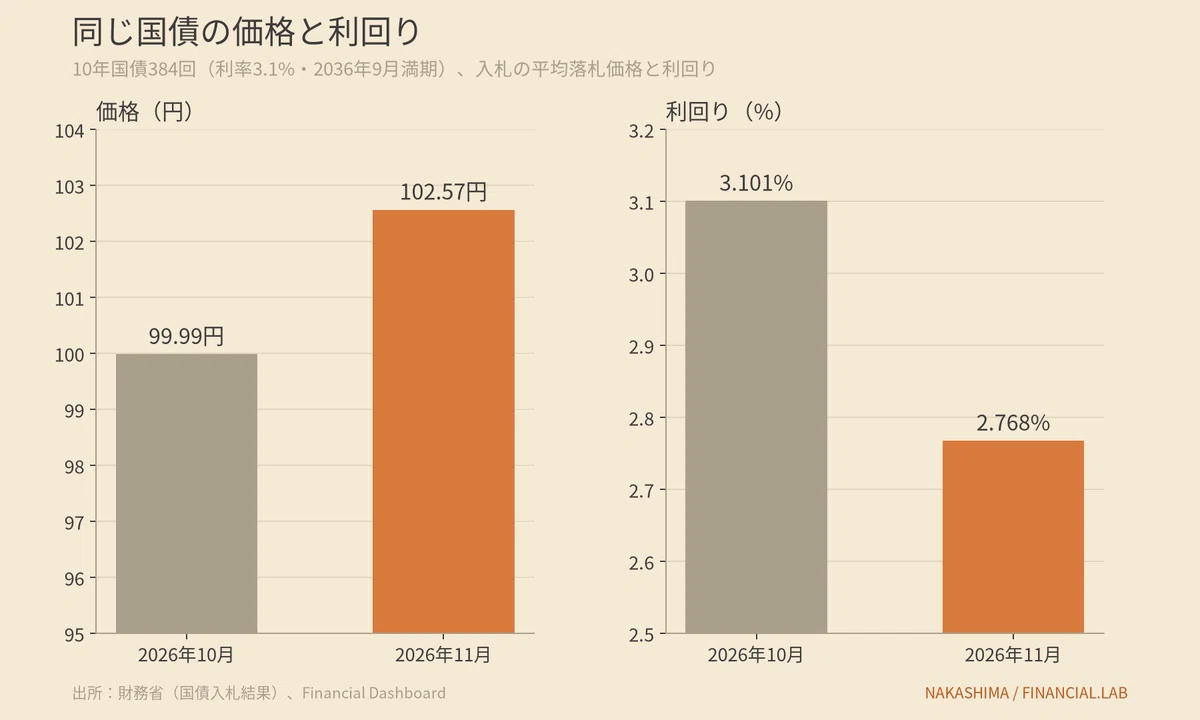
‘When the price goes up, the yield goes down. When the price goes down, the yield goes up. Price and yield move in opposite directions.’
‘Why do they move in opposite directions?’
‘If you understand that, you can read most bond news. Let’s look at it in order.’
From here on, I will explain it so that it can be used as a dictionary.
■ What is yield?
Yield is the annual rate of return when purchased at the current price and held until maturity.
Bond returns are divided into two parts. One is the interest received every year, and the other is the difference between the purchase price and the face value (100 yen) returned at maturity. Yield indicates what percentage these two combined represent per year.
■ The difference between coupon rate and yield
The coupon rate is determined at the time of issuance and does not change until maturity. If the face value is 100 yen and the coupon rate is 3.1%, you will receive 3.1 yen in interest every year.
On the other hand, yield changes depending on the purchase price. Even with the same 3.1 yen in interest, if you buy it for 100 yen, it is close to 3.1%, but if you buy it for 102.57 yen, it will be lower than that. This is because the difference between the 100 yen returned at maturity and the higher purchase price becomes negative.
The interest rate of newly issued government bonds is set at a level close to the market yield at that time.
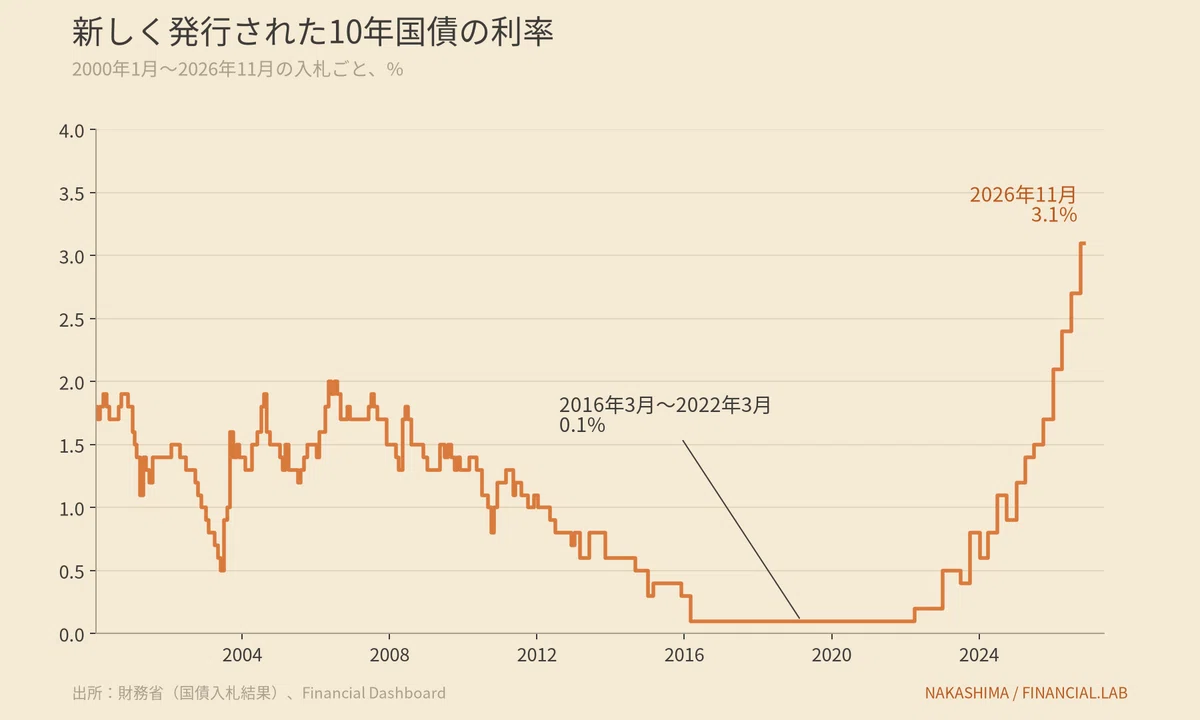
As shown in this chart, the interest rate on 10-year government bonds remained at 0.1% for a long time, but has now risen to the 3% range. The last time a 10-year government bond with a 3.1% interest rate was issued was 30 years ago, in 1996.
■ Why Price and Yield Move in Opposite Directions
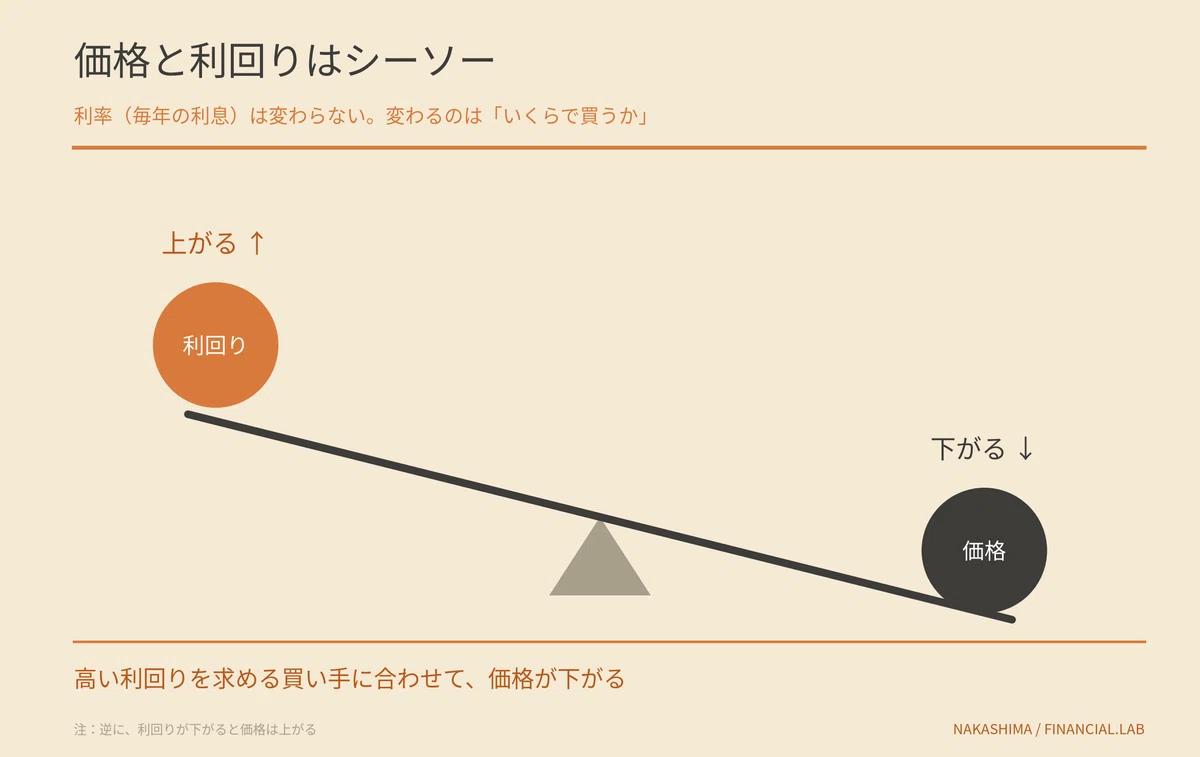
The price falls in order to provide a higher yield to the next buyer.
Suppose you hold a government bond with a 3.1% interest rate and market interest rates rise to 4%. Since newly issued government bonds will have an interest rate close to 4%, no one will buy a 3.1% bond for 100 yen.
To sell it anyway, you have no choice but to lower the price. If you buy it for less than 100 yen, the capital gain until 100 yen is returned at maturity is added, and the buyer’s yield approaches 4%. In this way, when interest rates rise, the price of existing bonds falls. When interest rates fall, the opposite happens.
The same movement can be seen in actual government bonds. These are the price and yield of a 10-year government bond (364th issue, 0.1% interest rate) issued five years ago in October 2021.
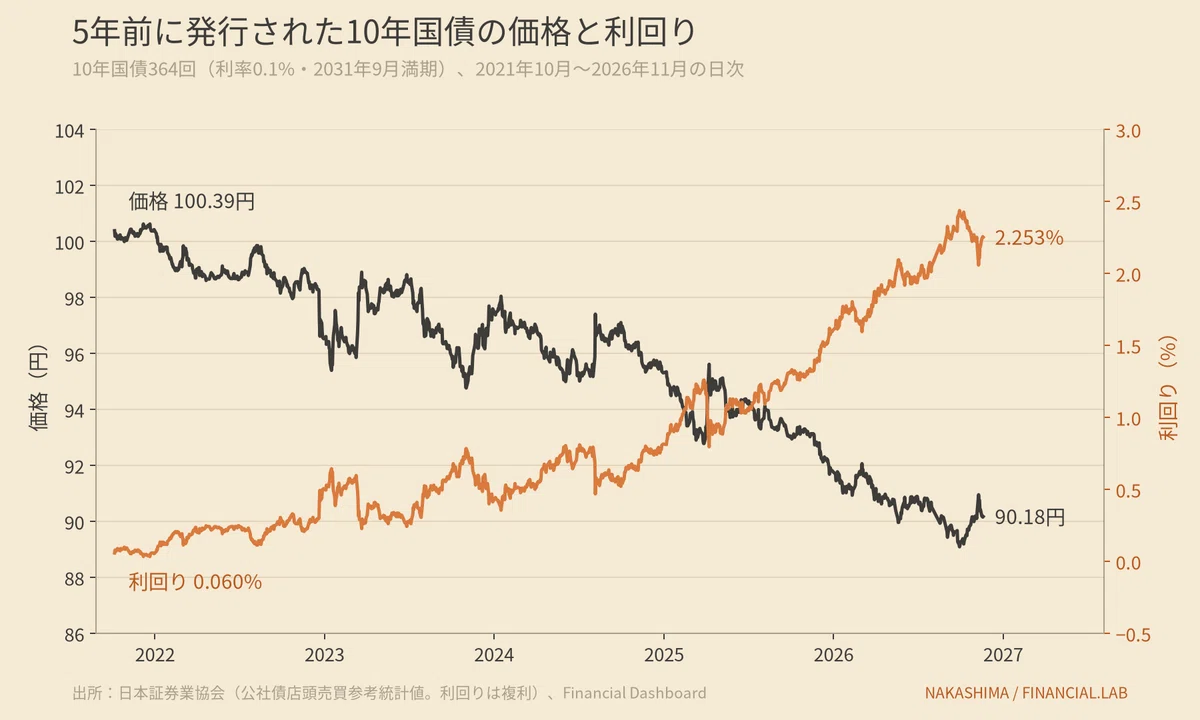
As shown in this chart, as the yield has risen, the price has fallen. The two lines move as if they were reflected in a mirror.
If we calculate based on a bond with a 3% interest rate and 10 years remaining, the relationship between price and yield is as shown in the following chart.
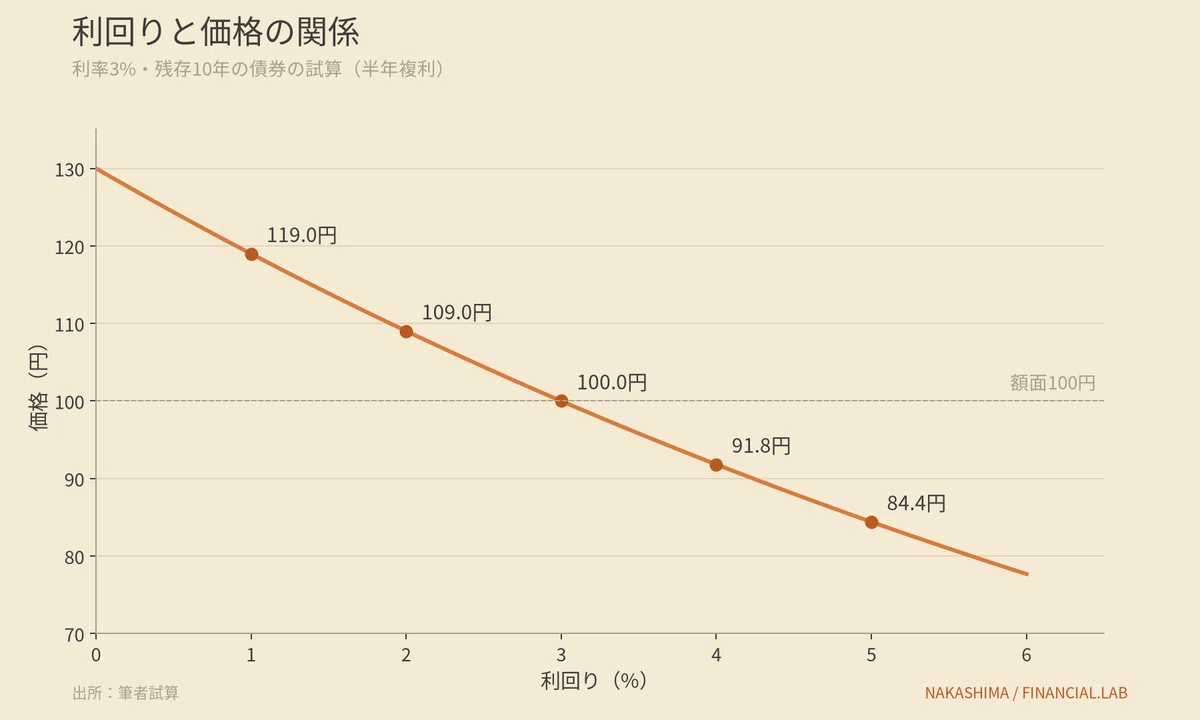
When the yield is 3%, the same as the interest rate, the price is exactly 100 yen. When the yield moves by 1%, the price moves by about 8 to 10 yen. The longer the time until maturity, the greater this movement becomes.
■ Simple Yield, Compound Yield, and Direct Yield
There are three ways to calculate yield.
-
Direct Yield: Interest rate ÷ Price. Looks only at one year’s worth of interest.
-
Simple Yield: (Interest rate + (100 – Price) ÷ Remaining years) ÷ Price. The amount of capital gain or loss is divided equally by the number of years and added.
-
Compound Yield: Calculated by assuming that the interest received is reinvested at the same yield.
The difference between direct yield and simple/compound yield is whether or not ‘redemption profit/loss’ is considered. Redemption profit/loss is the difference between the face value returned at maturity and the purchase price.
If you buy a bond with a face value of 100 yen for 70 yen, the 30 yen difference from the 100 yen returned at maturity also becomes profit. Simple and compound yields take this into account, while direct yield does not. However, direct yield is rarely used, so you don’t need to memorize it.
It is standard practice for Japanese government bonds to be indicated by simple yield. The yield from the Ministry of Finance’s auction results is also simple yield; calculating with the 384th issue in November gives (3.1 + (100 – 102.57) ÷ 9.88 years) ÷ 102.57 = 2.768%, which matches the announced value.
Even for the same government bond, the value differs slightly depending on the calculation method.
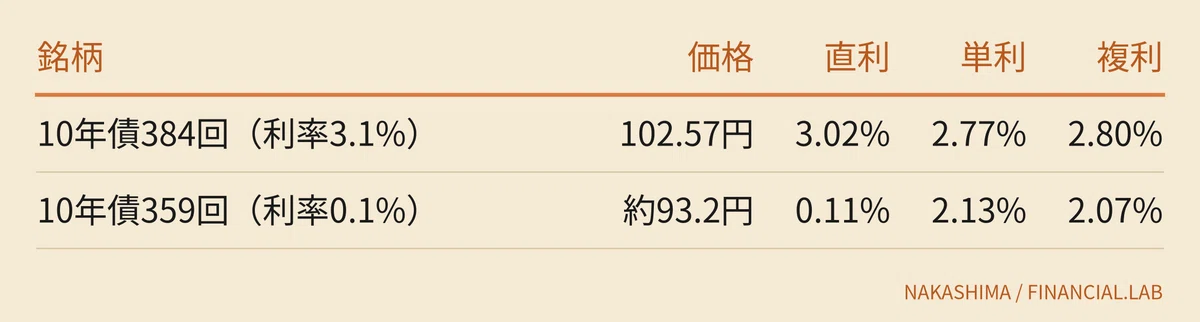
Note: The 384th issue is the average successful bid price for the November 2026 auction. The 359th issue matures in June 2030, and its price was estimated from the yield (approx. 2.07%) of a government bond with a similar duration. Compound yield is semi-annual compounding.
When the price is higher than 100 yen, the simple yield is lower, and when it is lower than 100 yen, the simple yield is higher. This is because simple yield simply divides the capital gain or loss by the number of years. The further the price is from 100 yen, the wider the difference becomes.
Therefore, the simple yield value shifts depending on the coupon rate. For a bond with 10 years remaining, when the compound yield is 2.80% for all, the simple yield becomes 3.19% for a bond with a 0.1% coupon rate, and 2.60% for a bond with a 5.0% coupon rate.
To accurately compare ‘which yield is higher’ between bonds with different coupon rates, use compound yield.
■ Over-par and Under-par
When the price is higher than the face value of 100 yen, it is called over-par, and when it is lower, it is called under-par. Exactly 100 yen is ‘par’.
In the July 2016 auction, a 10-year government bond (343rd issue) with a 0.1% coupon rate was bought at 103.5 yen, and the yield was minus 0.243%. Even if you receive interest, the difference from the 100 yen returned at maturity is greater, making it a price that results in a loss if held until maturity. Now, a government bond with the same 0.1% coupon rate (359th issue) is priced significantly below 100 yen. This is because the price has fallen as interest rates have risen.
■ Summary
-
Yield is the annual rate of return when purchased at the current price and held until maturity.
-
The coupon rate is determined at issuance and does not change. Yield changes based on the purchase price.
-
Price and yield move in opposite directions. When interest rates rise, the price of existing bonds falls.
-
The yield on Japanese government bonds is expressed as a simple interest rate. The value differs slightly from direct yield and compound interest.
-
A price higher than 100 yen is called ‘over par,’ and a lower price is called ‘under par.’
■ Points to Note
This article explains the mechanics of bonds and does not recommend the buying or selling of any specific bond. Yields and prices are values at the time of writing and change daily. The price of 359 yen is the author’s estimate and differs from actual trading prices.
■ List of New Bond Investment Articles
See other installments in the series here.
https://note.com/take832/m/m35b988501393
See the list of all previous articles here.
https://www.finlab.jp/library/
Thank you for reading to the end. All past articles are available exclusively to members.
■ Book Information
On November 26, I will release ‘Amazing Diversified Investment’ (Subtitle: Unbeatable, Solid, Yet Profitable) from Diamond Inc. It is already available for pre-order on Amazon and elsewhere. Design an unbeatable investment strategy based not on ‘what to buy,’ but on ‘what, when, and what to combine it with.’ I have summarized the entire picture in this one book.
-
Book Overview