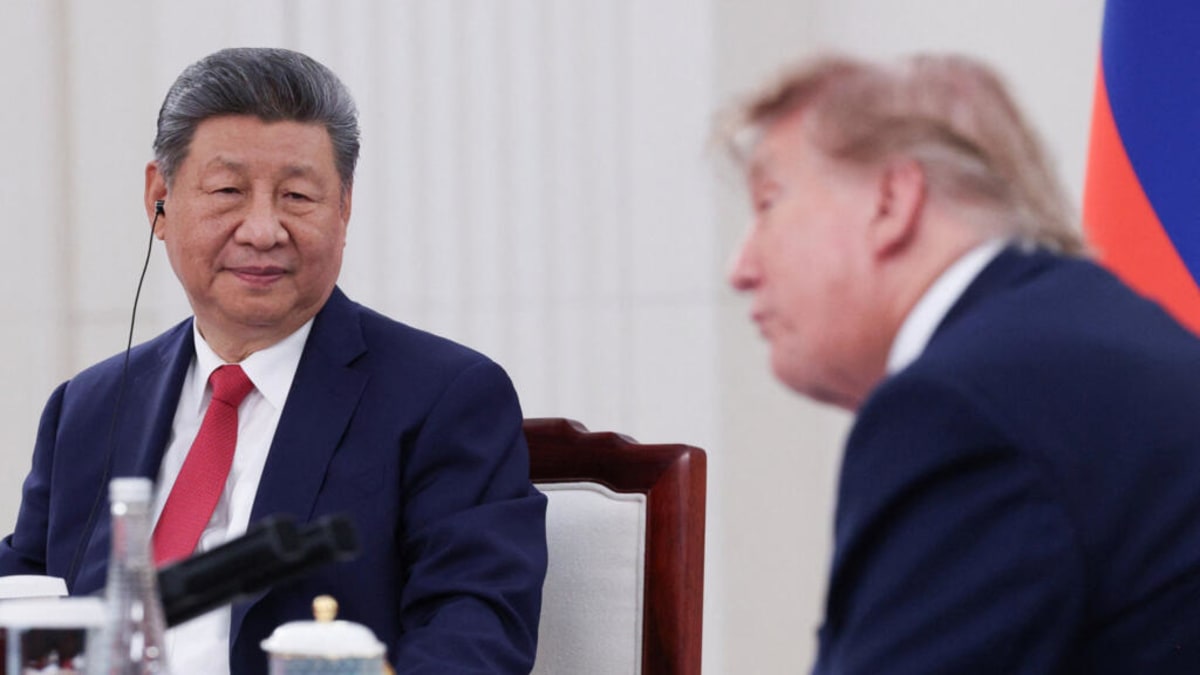
Sometimes the meeting is the message.
The three-way talks between Chinese President Xi Jinping, US President Donald Trump and Russian President Vladimir Putin in the Chinese tech capital of Shenzhen Thursday lasted all of 90 minutes.
Just what exactly the three men said to one another through their interpreters during that hour-and-a-half will remain a mystery.
Certainly, the joint “Declaration toward Peace” published afterwards by Beijing and Moscow gave little away: unspecified UN reforms, agreement to boost global oil production, a terse warning to the International Criminal Court and similar global bodies not to “abuse their jurisdiction” and a unanimous agreement that nuclear wars left no winners alive to celebrate.
Read moreHistoric trilateral summit live: Trump, Xi and Putin agree that a nuclear war must never be fought
While some watchers had warned not to expect any major announcements, others had raised fears that the historic meeting on the sidelines of the Asia-Pacific Economic Cooperation forum would be a new Yalta Conference.
About us, without us
The 1945 summit between the leaders of the allied Soviet Union, United States and Britain decided the shape of the global institutions that would rise out of the ashes of World War II and the fate of the eastern European countries following the defeat of Nazi Germany and its fascist allies.
With Russia’s brutal campaign in Ukraine dragging deeper into its fifth year, Ukraine’s President Volodymyr Zelensky warned against a new meeting between the self-identified superpowers that threatened to once again divide the world up into discrete spheres of influence – regardless of the impact on the peoples who found the borders shifting beneath their feet.
While Beijing and Moscow had both brushed aside comparisons with the conference, the carefully orchestrated spectacle of Xi, Trump and Putin as a 21st-century incarnation of Yalta’s “Big Three” did much to drape the three men with the trappings of World War II-style “great powers”.
But speaking to FRANCE 24 in the hours ahead of the meeting, Jean-François Di Meglio, steering committee chair of the Asia Centre think tank, said that parallels between Thursday’s talks and the discussions that ushered in the end of World War II didn’t stand up to scrutiny.
“The term ‘multipolarity’ is essential – and that’s why the comparison that’s often been made with Yalta doesn’t work,” he said. “Because there was a form of membership, a system where each participants’ differences were recognised … Whereas here, what matters most is China’s refusal in principle of a single world order under the aegis of common principles.”
Under the banner of multipolarity, China has for years championed a reworking of the international system that would give more weight to voices from the underdeveloped Global South – of which it has set itself up as an unofficial standard bearer.
Di Meglio said that China’s desire to overturn the Western hegemony that has reigned since the latter half of the 20th century should not be mistaken for altruism.
“While this multipolarity – which is being preached with a certain degree of opportunism, as we can see all too clearly in the way this meeting has been organised – is indeed China’s guiding principle, is it a sincere one or not? It is obvious that everything is being done in China’s best interest.”
A tenuous truce
Despite the warm words that Trump and Xi had for one another, the talks seem to have done little to resolve the simmering tensions between the two powers. Beijing’s threat last year to withhold critical rare earth exports won them a reprieve from Trump’s trade war, but the truce ends in January.
China has so far been one of the few countries to go toe-to-toe with the US after Trump unleashed a slew of tariffs against allies and adversaries alike, leveraging its unquestioned dominance in the rare earth and critical minerals supply chains that form the bedrock of the world’s cutting-edge technologies.
The US on Monday tightened rules around the export of advanced computing chips crucial for the development of frontier AI, an industry where US corporations still seem to hold an advantage over their Chinese rivals. The rules also restrict Chinese access to overseas data centres that would allow companies to access advanced computing power remotely.
With the Democrats having seized the House and Senate from Trump’s Republicans in the midterm elections earlier this month, Di Meglio said that foreign policy would become even more central to the president’s final two years in office.
“Artificial intelligence has raw materials, and those raw materials are rare earths,” he said. “And in Donald Trump’s mind, figuring out how to break this deadlock must be very, very high on his list of priorities.”
While the US has begun investing heavily in building up its own rare earth supply chains across the world, these projects will likely take years to bear fruit.
Di Meglio said that behind the smiles and handshakes at Shenzhen was a growing effort by both countries to extract themselves from their decades-old economic interdependence.
“There is both a willingness to decouple and, at the same time, the recognition that this decoupling can’t happen overnight, that it has to be managed,” he said. “And the ones who have already have a head start on this decoupling are the Chinese, because they saw this decoupling coming and entered into what’s called an autonomous war economy – and much more so than the US. But everyone is on this same path now.”